>_ ANALYSIS
The first F-35C cycle on John F. Kennedy narrows one question, not all of them
The first F-35C launches and recoveries on PCU John F. Kennedy shift the Ford-class debate from basic compatibility to the harder question of repetition. If the Navy can now cycle the jet through EMALS and AAG on a Ford-class deck, the remaining risk is less about whether the architecture can work at all and more about

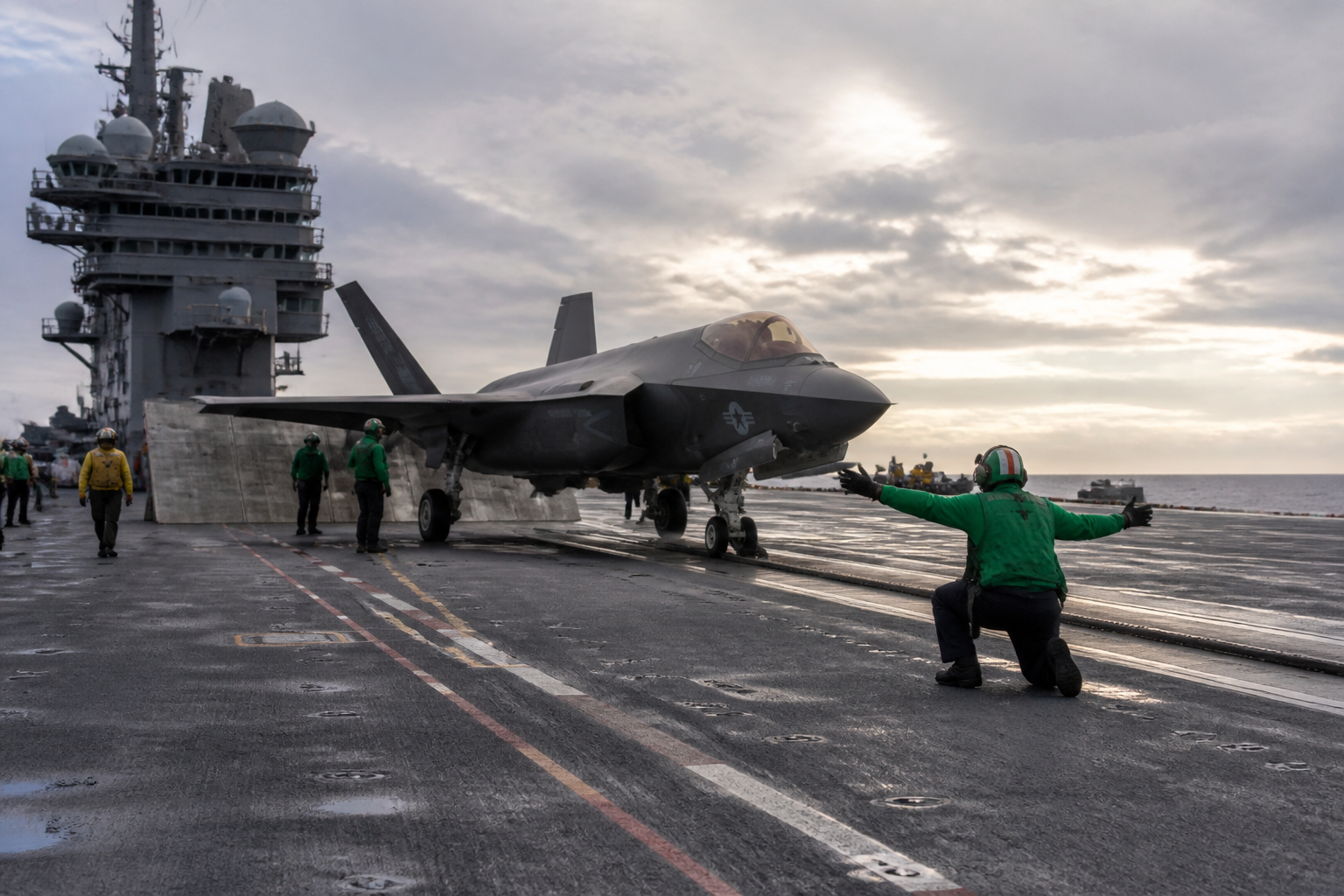
The first F-35C launches and recoveries on PCU John F. Kennedy shift the Ford-class debate from basic compatibility to the harder question of repetition. If the Navy can now cycle the jet through EMALS and AAG on a Ford-class deck, the remaining risk is less about whether the architecture can work at all and more about whether it can be sustained under normal operating pressure.
Naval News says VX-23 F-35Cs embarked on the carrier beginning October 13 and completed catapult launches and arrested recoveries on October 14. That is the specific development that matters: not a design promise, but a live test of the ship, aircraft and recovery system together. It also undercuts any blanket claim that the Ford class cannot support the F-35C in principle.
The mechanism is straightforward. Carrier aviation is not validated by a single successful event; it is validated when aircraft, deck handling, launch gear, arresting gear and maintenance tempo all fit together repeatedly. A one-time demonstration reduces uncertainty about integration, but it does not eliminate uncertainty about pace, reliability or how the system behaves under heavier operational demand. The result is a narrower, more useful assessment: the Ford class now appears technically able to host the F-35C in this test configuration, but that is not the same as proving routine fleet use.
A stronger alternative explanation is that this is primarily a test-squadron milestone on a yet-to-be-commissioned ship, not evidence of durable combat readiness. That reading is credible. VX-23 exists to evaluate systems, and the report does not show a full air wing, sustained sorties or long-duration maintenance performance. So the right judgment is modest: the event is meaningful because it demonstrates compatibility in practice, but limited because it only captures a narrow slice of operational reality.
That distinction matters for different readers in different ways. For the Navy, it reduces one integration unknown and makes it harder to argue that the Ford-class design itself is the blocker. For skeptics of the program, it does not settle the broader questions about cost, schedule or how much testing remains before the configuration is routine. Both positions can survive this milestone.
The useful signal to watch is repetition, not ceremony. If John F. Kennedy keeps hosting F-35C launches, recoveries and associated deck cycles without unusual constraints, the case for stable Ford-class compatibility strengthens. If follow-on activity remains sparse or tightly bounded, the event will look more like a controlled proof point than the start of normal operating use.
Source: https://www.navalnews.com/naval-news/2026/10/f-35c-commences-testing-on-ford-class-carrier-john-f-kennedy/